Guardianship of an elderly parent: how it works

August is when families find out. The daughter who flew in for a week of summer visits opens the kitchen drawer and finds eleven months of unopened mail, two lapsed insurance policies and a check written to a stranger for $4,000. Her father is cheerful, adamant that everything is under control, and cannot say what month it is. Nothing is legally wrong yet, because he never signed a power of attorney and he still owns every decision about his own money and his own care. That gap between what a parent can safely manage and what the law still lets him do is where guardianship lives. It is a serious step, it is slower and more expensive than most families expect, and in a good number of cases it is avoidable entirely. This guide sets out how adult guardianship actually works in the United States, what it costs, what a court will ask you to prove, and the lighter alternatives worth trying first while there is still time to use them.
What guardianship actually is
Guardianship is a court proceeding in which a judge finds that an adult can no longer make or communicate decisions about their own welfare or property, and appoints someone else to make those decisions for them. The person losing authority is usually called the ward, the protected person or the respondent depending on the state. Some states use the word conservatorship for financial authority and reserve guardianship for personal and medical decisions, while others use one word for both. What matters is not the label but the scope of the order the judge signs, because that document defines exactly what you may and may not do. Ask the attorney for a plain reading of the proposed order before the hearing rather than after.
Guardianship of the person versus the estate
Guardianship of the person covers where your parent lives, what medical treatment they receive, who may visit and day to day welfare. Guardianship of the estate, often called conservatorship, covers bank accounts, income, property, bills, taxes and any legal claims. The two are granted separately and a court can award one without the other. A parent with dementia who has a stable income and a joint account with a trusted child may only need authority over care decisions. A parent who is cognitively fine but physically unable to manage a rental property may only need help with the estate side.
Why courts prefer the least restrictive option
Every state now applies some version of a least restrictive alternative standard, drawn from the Uniform Guardianship, Conservatorship and Other Protective Arrangements Act published by the Uniform Law Commission. The principle is simple. If a lesser arrangement can meet the person's needs, the court should not strip their rights. Judges increasingly ask petitioners to show what else was tried and why it failed. Arriving with an answer to that question is the single biggest factor in how smoothly a petition goes.
The lighter options to try first
Most families reach for guardianship because nobody told them the other rungs exist. Work up from the bottom of this list rather than down from the top, and expect that a combination of two or three lighter tools will cover a large share of what a full order would have covered.
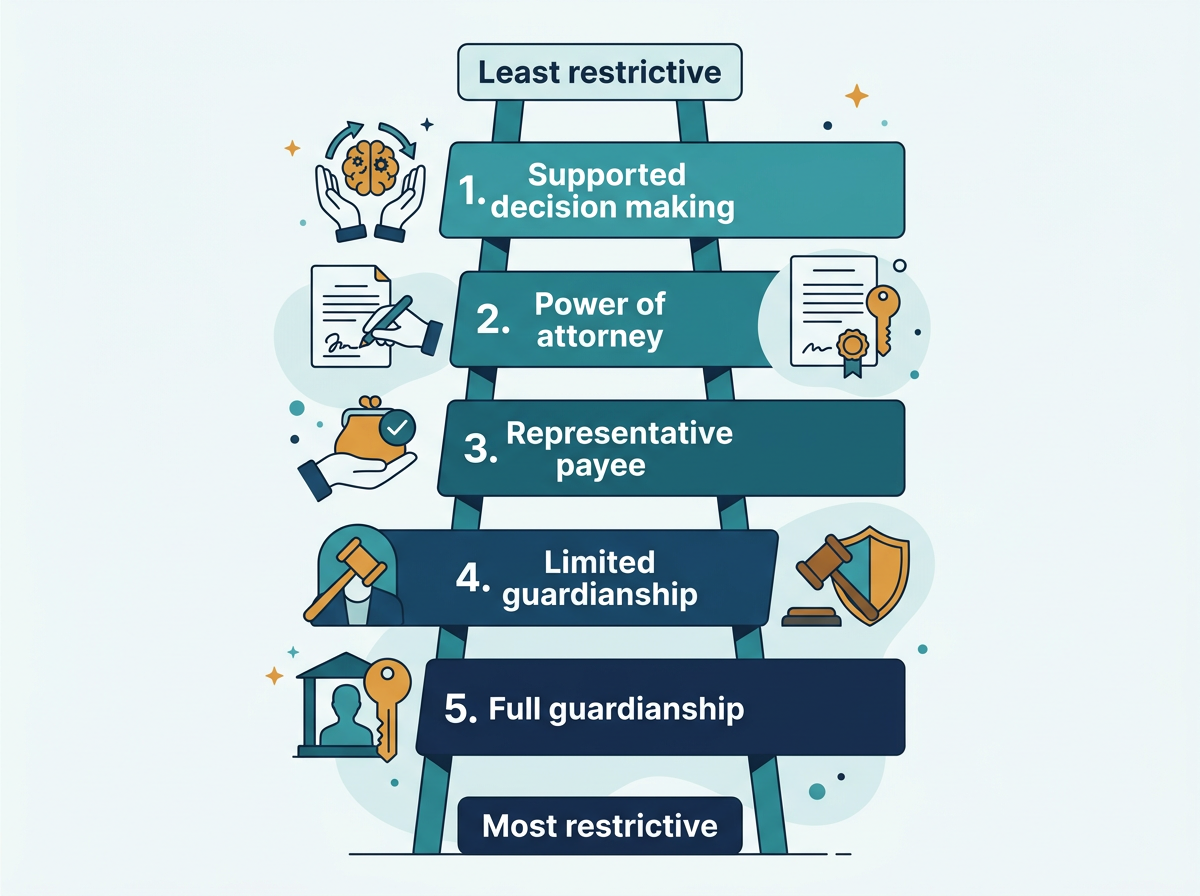
Six alternatives worth exhausting
Durable power of attorney for finances, signed while your parent still has capacity, gives you authority over money without a court. A healthcare power of attorney or proxy does the same for medical decisions, and the National Institute on Aging guide to advance care planning explains how the documents fit together. A representative payee arrangement through Social Security lets one person receive and manage benefit payments for another. A VA fiduciary appointment does the equivalent for veterans' benefits, described at the VA fiduciary program. A revocable living trust with a successor trustee moves assets under managed control without any court filing. Supported decision making agreements, now recognized in a growing number of states, keep the person as the legal decision maker while formalising who helps them think it through.
When guardianship really is necessary
There are situations no lesser tool solves. A parent who has already lost capacity cannot sign a power of attorney, because signing one requires understanding it. A parent being financially exploited by a new friend or an estranged relative may need an order that voids the exploiter's access quickly. A hospital may refuse to discharge a patient with no decision maker, leaving a person stuck on a ward for weeks. Siblings who cannot agree sometimes need a judge to settle who decides. In each of these, the delay caused by trying softer options first is itself a harm.
What the court process looks like
A petition is filed in the county where your parent lives, naming the proposed guardian, describing the alleged incapacity and listing close relatives who must be notified. The court appoints an attorney or a guardian ad litem to represent your parent's own interests, which is a protection rather than an obstacle. A physician or psychologist completes a capacity evaluation on a court form, and that report carries more weight than anything a family member says. A hearing follows, usually short if nobody objects and considerably longer if someone does. If the judge grants the petition, letters of guardianship are issued and those letters are the document banks and facilities will ask to see.
What it costs and how long it takes
An uncontested petition handled by an elder law attorney commonly lands between $3,000 and $7,000 once filing fees, the capacity evaluation, the court appointed attorney and a surety bond are counted. Contested cases with hostile siblings or a resisting parent can run past $15,000. Timelines vary by county, but six to twelve weeks from filing to letters is a fair expectation, with emergency or temporary orders available in days when there is immediate risk. Compare that with a power of attorney package, which most attorneys prepare for a few hundred dollars in a single appointment. The arithmetic is the strongest argument for acting before capacity slips.
The duties nobody warns you about
The order is the beginning, not the end. Most states require an initial inventory of assets within sixty to ninety days, an annual accounting filed with the court, and an annual report on the person's living situation and health. Guardians must keep the protected person's money strictly separate from their own, and commingling is the fastest route to removal and personal liability. Courts can require receipts, and some counties audit. Budget several hours a month for record keeping and factor in an accountant if the estate is more than a savings account and a pension.
Guardianship and nursing home admission
Facilities sometimes tell families that a nursing home cannot admit a resident without a guardian. That is not a federal requirement, and admission agreements cannot condition a bed on a third party assuming personal financial liability. Resident rights and admission protections sit at 42 CFR 483.10, and transfer and discharge rules at 42 CFR 483.15. What a facility legitimately needs is a clear answer to who signs consents and who handles payment. A power of attorney or a representative payee usually satisfies both. Our guide to nursing home resident rights covers what to do when a facility says otherwise.
Watch for conflicts of interest
Be cautious when the facility, a hospital discharge planner or a paid professional suggests that a specific person or agency be appointed. Professional guardians do valuable work where no family exists, but a guardian with authority over both the placement decision and the money has an obvious tension when the placement is the appointing facility. Ask who is proposing the guardian, who pays them, how many people they already serve and whether they will support family visiting. The Department of Justice Elder Justice Initiative publishes resources on guardianship abuse and where to report it. If something feels arranged rather than considered, say so to the court appointed attorney before the hearing.
How to choose the right guardian in a family
Geography usually beats seniority. The child who lives forty minutes away and can attend a care conference on a Tuesday morning will serve better than the eldest who lives three time zones away and travels for work. Split roles where the law allows it, with one sibling holding the estate and another holding personal decisions, because that spreads the workload and creates natural accountability. Anyone with a bankruptcy history, an addiction problem or a financial dependence on the parent should expect scrutiny and may be rejected. Agree in advance how information will be shared with the rest of the family, since most guardianship disputes start as communication failures rather than genuine misconduct.
Ending or narrowing an order
Guardianship is not permanent by design. A protected person, or anyone acting on their behalf, can petition to restore rights if capacity improves after a stroke, a delirium episode, a corrected medication problem or successful rehabilitation. Courts can also narrow a full order into a limited one, returning the right to vote, marry, choose a doctor or decide where to live. Terminating an order requires medical evidence and a hearing, and it is genuinely granted, so do not treat a first ruling as the final word. Guardians who no longer wish to serve must ask the court to be discharged rather than simply stopping.
What to do in the next fortnight
If your parent still has capacity, book an elder law appointment this month and get the financial power of attorney, healthcare proxy, advance directive and HIPAA release signed together. If capacity is already gone, start the county process now rather than in December, because court calendars thin out badly through the holidays and hospital discharge pressure does not. Call the Eldercare Locator on 1-800-677-1116 for a referral to your local Area Agency on Aging, which can point you to low cost legal help. Then check the quality data on any facility under consideration through Medicare Care Compare or by using our search by city or state and side by side comparison tool.
Frequently asked questions
Authoritative sources
Figures, rules and claims in this post are drawn from these official and independent sources.
- Advance Care Planning: Advance Directives for Health Care
National Institute on Aging
- Uniform Guardianship, Conservatorship and Other Protective Arrangements Act
Uniform Law Commission
- VA Fiduciary Program
U.S. Department of Veterans Affairs
- Elder Justice Initiative
U.S. Department of Justice
- Eldercare Locator
Administration for Community Living
- 42 CFR 483.10: Resident rights
Electronic Code of Federal Regulations
- 42 CFR 483.15: Admission, transfer and discharge rights
Electronic Code of Federal Regulations
- Care Compare: nursing home quality and staffing ratings
Medicare.gov, CMS
Related guides on this site
More from the blog


About this post
Written and reviewed by the Nursing Home Match editorial team. We update posts as the underlying rules and data change. This post is general information, not personal medical, financial or legal advice, always confirm details on Medicare.gov Care Compare or My Aged Care before making decisions.