Is long-term care insurance worth it? A 2026 breakdown

September is when the mail arrives. Insurers send annual policy statements and rate increase notices in the weeks before Medicare open enrollment opens on 15 October, and every year the same phone call follows: a daughter looking at her mother's premium notice, trying to work out whether the policy her parents bought in 2009 is still worth funding, or whether she should be buying one herself at 57. Both questions have answers, and neither of them is the sales pitch. Long-term care insurance is a narrow financial product that pays out under specific clinical conditions, gets refused to a large share of people who apply late, and rewards buyers who purchase early with compound inflation protection. It is genuinely worth it for one group of households and a poor use of money for two others. This is how to work out which group you are in before the next premium is due.
What the policy actually buys
Long-term care insurance does not pay doctors or hospitals. It pays for custodial care, which means help with bathing, dressing, toileting, transferring, continence and eating. Medicare covers none of that on an ongoing basis, and the Medicare rules on skilled nursing coverage cap post-hospital stays at 100 days with a large daily copayment from day 21. A policy fills exactly that gap. Most modern plans pay a daily or monthly maximum into a total benefit pool, and the pool can usually be spent on a nursing home, an assisted living residence, adult day care or a paid carer at home, which matters because roughly three quarters of claims start at home rather than in a facility.
The 2026 price of care it is insuring against
The number that decides whether a premium is rational is the cost of the care itself. Nationally the median private room in a nursing home now runs a little over $10,000 a month, a semi-private room close to $9,000, and assisted living around $5,500. Those are medians, so a metro market on either coast sits well above them. The National Institute on Aging estimates that someone turning 65 today has roughly a 70 percent chance of needing some long-term care, with women averaging about 3.7 years of it and men about 2.2. Check the real rate in your own market on our nursing home search before accepting any national average, because the gap between Mississippi and Connecticut is more than double.
What a policy costs at 55, 60 and 65
Price is driven by age at purchase, health, the size of the benefit pool and whether inflation protection is attached. A single applicant in good health buying a traditional policy at 55 with a three year pool and 3 percent compound inflation generally sees $950 to $1,700 a year. The same policy at 60 lands nearer $1,400 to $2,400, and at 65 it commonly passes $3,000. Couples buying together receive a discount of 15 to 30 percent and can share a single pool, which is the best value structure in the market. Every year of delay adds roughly 3 to 5 percent to the premium before any health change is priced in, which is why the mid fifties is the standard advice rather than a sales tactic.
Why so many applicants are declined
Cost is not the main barrier. Underwriting is. Insurers review medical records, run a phone or in person cognitive screen, and check prescription histories. Applicants are routinely declined for existing cognitive impairment, Parkinson's disease, multiple sclerosis, an existing need for help with daily tasks, recent stroke, oxygen dependence, kidney failure and uncontrolled diabetes with complications. Industry decline rates run near 20 percent at age 60 and close to 45 percent at 70. That single fact reorders the whole decision. If a policy is on the table at all, it is on the table now, and a household that intends to buy at 68 after the mortgage clears is planning on a product it may not be allowed to have.
How a claim is actually triggered
Benefits do not start when a doctor recommends a nursing home. They start when a licensed assessor certifies one of two benefit triggers set out in federal tax law: the person cannot perform at least two of the six activities of daily living without substantial assistance and is expected to need that help for at least 90 days, or has a severe cognitive impairment requiring substantial supervision. The certification must be renewed annually. Families are frequently caught out because a parent who is frail, lonely and unsafe alone may still dress and feed themselves, which means the policy pays nothing until function declines further.
The elimination period is a bill you pay yourself
Every policy carries a waiting period, usually 30, 60, 90 or 100 days, that runs from the date care begins. The household pays privately for that entire window. At current rates a 90 day elimination period on a nursing home stay is a self-funded bill of around $30,000. Read whether the policy counts calendar days or service days, because a service day version only counts days on which paid care was actually delivered, and three visits a week can stretch a 90 day requirement across seven months. Ask also whether the period is once per lifetime or resets with each new claim.
Inflation protection is the whole product
A $200 daily benefit sounds generous until it is discounted forward twenty five years. With 3 percent compound inflation protection that benefit grows to roughly $419 a day by the time a 55 year old buyer is 80. Without it, the same $200 is buying under half of what it does today, and the family funds the difference. Simple inflation protection, which grows the benefit by a fixed percentage of the original amount rather than compounding, costs less and lags badly over long holding periods. If the premium with compound protection is unaffordable, reduce the benefit pool or lengthen the elimination period first. Cutting inflation protection to save money defeats the reason for owning the policy.
Traditional versus hybrid policies
Traditional standalone policies give the most care benefit per dollar, but the premium is not guaranteed and carriers have pushed through repeated increases on older blocks of business, some above 50 percent. Hybrid policies attach long-term care benefits to a life insurance policy or an annuity, usually for a single premium or a fixed ten year payment schedule. Their appeal is certainty: the premium cannot be raised, and if care is never needed a death benefit passes to heirs. The trade off is efficiency, since the same money typically buys a smaller care pool. Households that hate the idea of paying for something they may never claim tend to choose hybrids, and there is nothing wrong with paying for that certainty as long as it is priced honestly.
The rate increase letter, and what to do with it
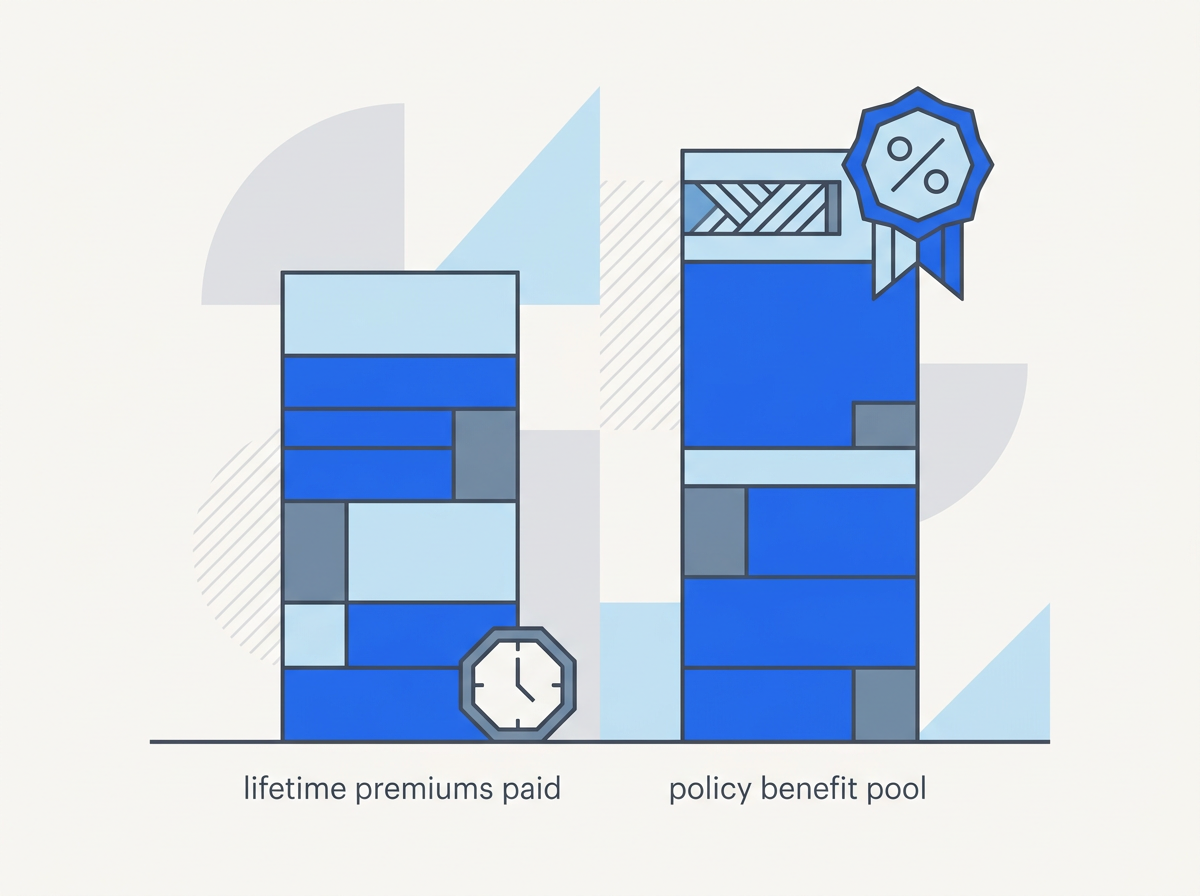
Existing policyholders receiving an increase this autumn have four options, and quietly paying is only one of them. State insurance departments approve these increases, and carriers are required to offer a reduced benefit alternative alongside the higher premium. Consider shortening the benefit period from lifetime to three or four years, reducing the daily benefit modestly, or accepting a contingent nonforfeiture offer, which converts the policy to a paid up plan with a benefit pool equal to premiums already paid. Lapsing a policy held for fifteen years and taking nothing is the worst available outcome. Your state insurance department can confirm what was approved and on what basis.
The Partnership program most buyers never hear about
More than 40 states run a Long-Term Care Partnership program. Buying a qualifying policy lets the owner protect an extra dollar of assets from Medicaid spend down and estate recovery for every dollar the policy pays out. Someone whose policy pays $300,000 in benefits can keep $300,000 in assets above the usual limit and still qualify for Medicaid afterwards. That converts the policy from a bet on never needing Medicaid into a bridge that protects the estate while the money runs out. Ask any agent in writing whether the policy is Partnership qualified in your state, then read our explanation of the Medicaid look-back period so the two rules are planned together rather than in sequence.
Tax treatment nobody claims
Premiums on a tax qualified policy count as a medical expense and are deductible to an age based limit if total medical costs exceed 7.5 percent of adjusted gross income, with the cap for a taxpayer over 70 sitting above $6,000 a year. Business owners get better treatment still, since a C corporation can generally deduct the full premium for an owner employee and spouse. Benefits received are normally tax free up to the per diem limit published annually by the IRS. The rules sit in IRS Publication 502, and they are worth an hour with an accountant because self employed households often leave a meaningful deduction unclaimed for years.
When paying privately is the better answer
Insurance is not the right tool for everyone. Households with investable assets above roughly $2.5 million can usually self fund several years of care without changing their standard of living, and the premium is better deployed elsewhere. At the other end, a household with under $75,000 in savings and modest income will likely reach Medicaid eligibility quickly, and paying premiums for years only to spend down anyway wastes money that could support a carer today. The middle band, broadly $200,000 to $2 million in assets, is where a policy earns its place, because that is exactly the range that a three year private-pay stay destroys. Compare it against the alternatives in how to pay for a nursing home without Medicaid.
Questions to ask before signing anything
Insist on written answers. Is the policy Partnership qualified in my state, and what is the exact inflation option? Is the elimination period counted in calendar days or service days, and does it reset per claim? Does the pool cover home care and assisted living at the same daily rate as a nursing home, or at a reduced percentage? What is the carrier's rate increase history on this product line over the last fifteen years, and its financial strength rating? Is there a waiver of premium once a claim begins? Who assesses the benefit trigger, and can the family appeal a denial? An agent who will not put those answers on paper is telling you something useful.
What to do before the year ends
If a policy is already in force, pull the annual statement out of the September mail, confirm the current daily benefit, the remaining pool and the inflation option, and store the policy number where an adult child can find it, because unclaimed policies are a common and expensive loss. If you are shopping, get quotes from at least three carriers through an independent broker rather than a single captive agent, and do it before a birthday resets the age band. For unbiased help, your State Health Insurance Assistance Program offers free counselling, and the Eldercare Locator on 1-800-677-1116 connects to the Area Agency on Aging. Then look at the real facilities and rates you would actually be insuring against, using Medicare Care Compare and our side by side comparison tool.
Frequently asked questions
Authoritative sources
Figures, rules and claims in this post are drawn from these official and independent sources.
- Skilled nursing facility care coverage
Medicare.gov
- What is long-term care?
National Institute on Aging
- Paying for long-term care
National Institute on Aging
- Publication 502, Medical and Dental Expenses
Internal Revenue Service
- State insurance department directory
National Association of Insurance Commissioners
- State Health Insurance Assistance Programs
SHIP National Technical Assistance Center
- Eldercare Locator
Administration for Community Living
- Care Compare for nursing homes
Medicare.gov
Related guides on this site
More from the blog


About this post
Written and reviewed by the Nursing Home Match editorial team. We update posts as the underlying rules and data change. This post is general information, not personal medical, financial or legal advice, always confirm details on Medicare.gov Care Compare or My Aged Care before making decisions.