Memory care vs nursing home: which one fits dementia?
Picking between memory care and a nursing home is the question almost every dementia family eventually faces, and it almost never has a clean answer on the first try. The two settings look similar from the parking lot. They are licensed under different rules, staffed by different mixes of professionals, paid for by different programs, and designed for different stages of cognitive decline. June is Alzheimer's and Brain Awareness Month, which is when most family meetings about long-term placement actually happen, so this guide breaks down what each setting really delivers, how to map a person's dementia stage to the right level of care, what each costs in 2026, and the questions that separate a good memory care unit from one that is really just an assisted living with a coded door.
Same diagnosis, two different settings
A dementia diagnosis on its own does not point cleanly to either memory care or a nursing home. The two are licensed differently, staffed differently, designed differently, and paid for from different pots of money. Picking the right one comes down to where a person sits on the dementia trajectory and what other medical conditions are riding alongside the cognitive decline. Someone with early Alzheimer's who is otherwise physically well does not belong in a nursing home, where the average resident has four or more chronic conditions and the building is built around bed-based care. Someone with late-stage dementia who needs help with every transfer and is at high risk of pressure injuries usually does not belong in a memory care unit, where staffing ratios assume residents can still bear some of their own weight. The right setting is the one where the staffing model, the building design and the funding source all line up with the resident's current needs, with enough headroom for the next 12 to 18 months.
What memory care actually is
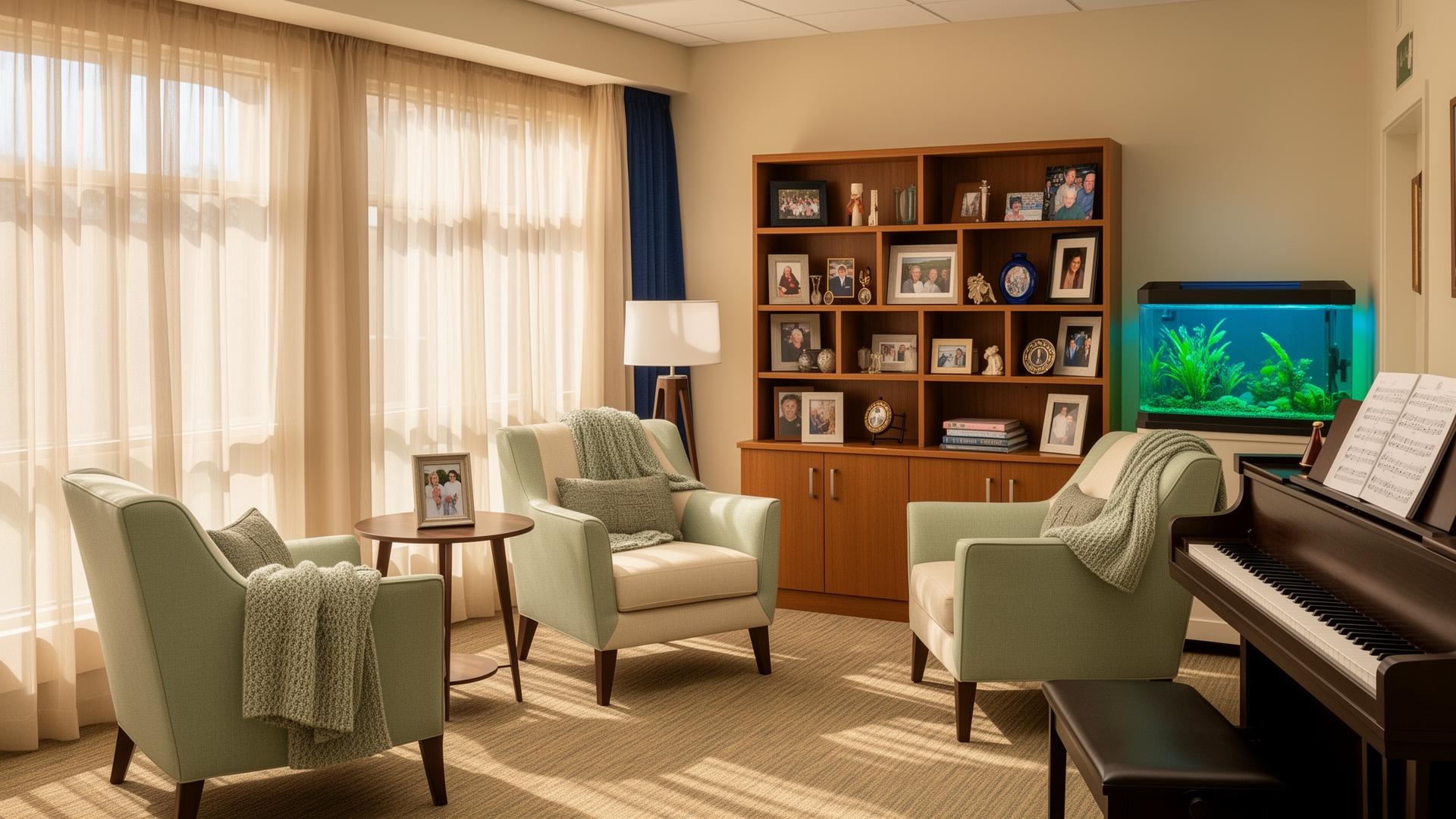
Memory care is dementia-specialized assisted living. In most states it is licensed as residential care or assisted living with an additional dementia-care endorsement, which adds requirements around secured exits, dementia-specific staff training (often 6 to 12 hours of initial training plus annual refreshers), smaller resident-to-staff ratios on the dementia neighborhood and design standards like circular walking paths, contrast-edged flooring and visible memory boxes outside each room. The day is built around routine, familiar music, life-skill stations (folding laundry, sorting tools) and small-group activities of 6 to 10 residents rather than the larger dining rooms of regular assisted living. Medications are administered by certified medication aides or LPNs, not by RNs, and most memory care communities do not have an RN on site overnight. That is the line that matters: memory care is built for social and behavioral support, not medical complexity.
What a nursing home does differently
A nursing home, also called a skilled nursing facility, is federally regulated under CMS rules and licensed by the state department of health. It is staffed for medical acuity: licensed nurses around the clock, certified nurse aides for hands-on care, on-site or contracted physical, occupational and speech therapy, plus a medical director. Roughly 60% to 70% of US nursing homes operate a dedicated dementia or memory care unit inside the building, usually a locked wing with its own dining room and activity space. The difference from a stand-alone memory care community is staffing depth: the nursing home dementia unit has an RN supervising every shift and can handle IV antibiotics, oxygen, tube feeding, complex wound care and two-person mechanical transfers without sending the resident to the hospital. The trade-off is environment. Even the best nursing home dementia unit feels more clinical than a purpose-built memory care community, with longer corridors, more medical equipment and a wider range of cognitive levels among neighbors. For a fuller side-by-side, see our guide on assisted living vs nursing home.
How dementia stages map to the right setting
A useful starting point is the Global Deterioration Scale, which clinicians use to stage dementia from 1 (no impairment) to 7 (very severe). Stages 4 and 5 cover most early-to-mid dementia: the person needs prompting with finances, complex tasks and sometimes dressing, but can usually walk, feed themselves and engage socially. Memory care is almost always the better fit at this stage. Stage 6 brings incontinence, wandering, sleep disruption and increasing care needs at every transfer; many people remain well-served in memory care if the community has strong overnight staffing and a good behavioral team, but this is the stage where families start touring nursing home dementia units. Stage 7 brings near-total dependence, swallowing difficulties, infection risk and immobility. At that point a nursing home dementia unit is usually the safer setting, both because of the round-the-clock RN coverage and because skilled wound, hospice and end-of-life support is built into the building. Layered medical conditions can shift the answer earlier: a person with stage 5 dementia plus advanced heart failure or insulin-dependent diabetes often needs nursing-home-level oversight even while still socially intact. The NIA's caregiving guidance is a useful sanity check on stage-appropriate care.

What each setting costs and who pays
The Genworth 2024 Cost of Care Survey puts the US median assisted living rate at $5,900 per month, with memory care typically running $1,000 to $1,800 above that base, so a realistic 2026 budget is $6,200 to $7,500 per month for a stand-alone memory care community. A semi-private room in a nursing home runs a national median of around $9,700 per month and a private room around $11,100, with significant regional variation (the New York City metro and coastal California are often 60% above the national median). Medicare does not pay for long-term care in either setting. Medicare's 100-day SNF benefit only covers short-term skilled rehab in a nursing home and never applies to memory care. Medicaid covers nursing home care in every state once the resident meets state asset limits (usually around $2,000 in countable assets), but covers memory care only through Home and Community Based Services waivers, which are available in about 44 states and usually have multi-year waiting lists. Veterans Aid and Attendance, long-term care insurance and family resources fill most of the rest. Whatever the setting, watch for the hidden ancillary fees (laundry, incontinence supplies, salon, level-of-care upcharges) that rarely appear in the headline rate.
Safety: the numbers that actually matter
Dementia changes the safety calculus of every care setting. Falls are the dominant concern in memory care: residents are mobile, often impulsive, and at elevated risk after sundown. Look for fall rates below 2 per resident per year on the community's internal data and ask whether the building uses pressure-sensitive floor mats, low beds and non-slip socks as a matter of policy. Elopement (a resident leaving the building unsupervised) is the single highest-acuity event in memory care, and a community should be able to tell you the exact number of elopement attempts and successful exits in the last 12 months without hesitation. In nursing home dementia units, watch instead for the staffing star on CMS Care Compare and the unplanned 30-day rehospitalization rate, both strong predictors of how the dementia unit is actually being run rather than how it is marketed. Antipsychotic medication use is the third measure to ask about: industry-wide use among long-stay nursing home residents has fallen to around 14% in 2025 per CDC dementia surveillance data, and a unit running materially above that without a documented psychiatric diagnosis is using sedation as a staffing substitute.
Touring during Brain Awareness Month
June is the busiest month of the year for memory care and nursing home tours, partly because Alzheimer's and Brain Awareness Month prompts family conversations and partly because adult children visit aging parents over the summer and see the decline first-hand. Use the timing to your advantage. Tour at three different times: a weekday morning (when staffing is densest), a weekend afternoon (when most facilities are leanest) and a weekday between 4pm and 7pm, the sundowning window when dementia behaviors peak. In memory care, watch how staff respond to a resident who is repeating the same question for the tenth time, whether activities are happening or whether residents are parked in front of a television, and whether the building smells of urine in the late afternoon (a near-certain signal of understaffed continence care). In a nursing home dementia unit, walk the long-term wing rather than the rehab gym, ask which RN is supervising tonight, and request the building's most recent CMS survey report at the front desk - they are legally required to make it available. Our full tour red flag checklist covers what to look for room by room, and the 20 questions to ask guide covers the conversation with the administrator.
The decision framework families actually use
After thousands of family conversations, three questions separate the right setting from the wrong one. First: does your person need a licensed nurse at the bedside every shift? If the honest answer is yes (insulin sliding scales, IV medication, oxygen titration, complex wound care, two-person transfers), the answer is a nursing home dementia unit, not memory care. Second: is the dominant risk medical or behavioral? Falls, wandering, sundowning, refusal to eat, agitation in groups - these are behavioral risks that memory care is purpose-built to manage. Pressure injuries, sepsis, recurrent pneumonia, swallowing failure - these are medical risks that need nursing home staffing depth. Third: what is the funding picture for the next three years? If the family will exhaust private funds within 18 months and the local Medicaid HCBS waiver list is three years long, starting in a Medicaid-certified nursing home (even one with a strong dementia unit) often produces more continuity than placing in memory care, spending down, and being forced to transfer at a fragile moment. The right answer is rarely permanent; most dementia journeys move from memory care to a nursing home dementia unit somewhere between stage 6 and stage 7. Build the first placement around where the person is now, with a clear plan for when (not if) the next move happens. When you are ready to shortlist, our provider comparison and search by city or state tools surface the staffing, ratings and ownership detail that decide which buildings deserve a tour.
Frequently asked questions
Authoritative sources
Figures, rules and claims in this post are drawn from these official and independent sources.
- 2025 Alzheimer's Disease Facts and Figures
Alzheimer's Association
- Care Compare: Nursing Homes
Centers for Medicare & Medicaid Services
- Genworth Cost of Care Survey 2024
Genworth Financial
- Caring for a Person with Alzheimer's Disease
National Institute on Aging
- Alzheimer Disease and Related Dementias data
Centers for Disease Control and Prevention
- Long-Term Care: Who Pays?
U.S. Department of Health and Human Services / ACL
- Home and Community Based Services Waivers
Medicaid.gov
- Residential Care Communities (NSLTCP)
National Center for Health Statistics, CDC
Related guides on this site
More from the blog


About this post
Written and reviewed by the Nursing Home Match editorial team. We update posts as the underlying rules and data change. This post is general information, not personal medical, financial or legal advice, always confirm details on Medicare.gov Care Compare or My Aged Care before making decisions.